
How Do We Pick a Vape Flavour That Suits Our Taste? A Practical Guide to Finding Your Flavour
Placeholder — what we check before a series hits the Oz-vapes shelf.
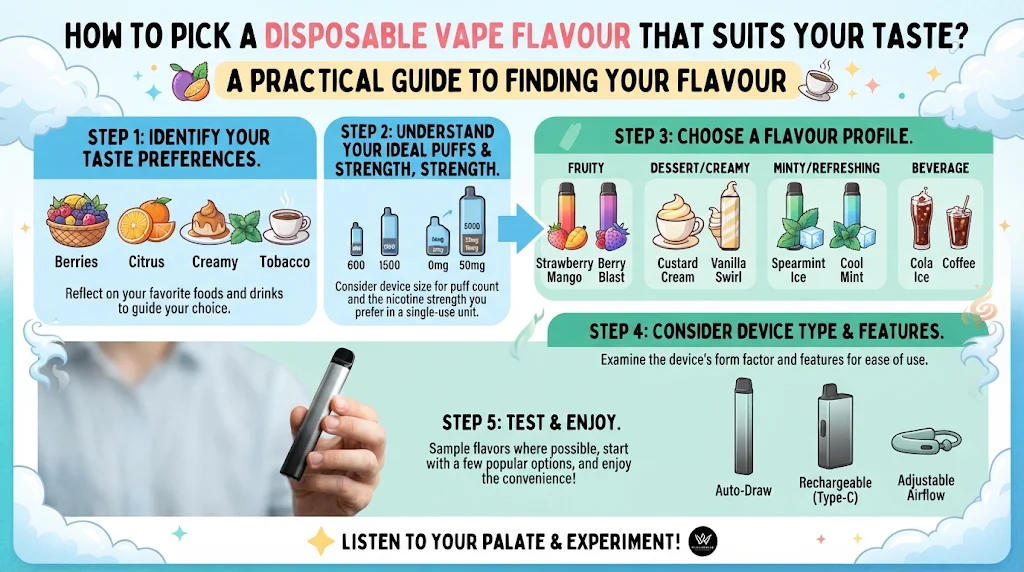

Here is the question almost everyone asks in the first ten minutes of looking at a vape shelf: how do I pick the right flavour? And here is the awkward part — almost nobody answers it well, including the people selling the devices. What you usually get instead is a wall of names you have never heard of, a recommendation from someone who has never asked what you like, and the quiet assumption that if you pick wrong the fault is yours.
That assumption is why so many people buy a device, taste it, decide they do not like vaping, and never come back. Not because vaping is bad for them, but because they picked a sweet, intensely flavoured candy profile when what they actually enjoy is a dry, cool, barely-sweet menthol, and then treated the mismatch as a verdict on the whole category.
This guide is about doing the opposite: working out what your own taste actually is, and then choosing a flavour deliberately instead of reactively. It does not assume you know the vocabulary — no flavour names are required — and it does not assume you want what is popular. It is built around a simple idea: taste is a set of preferences you can measure, not a mystery you have to guess at.
The short answer: Work out three things before you buy anything — how sweet you like it, whether you want cooling or warmth, and how strong a flavour you can handle. Everything else — fruit versus dessert, tobacco versus mint, familiar versus adventurous — is a smaller decision on top of those three. Get those right and almost any flavour will land. Get them wrong and no amount of product quality will save the experience.
Everything below is written for Australian vapers, in Australian English, and assumes nicotine vaping products regulated under the TGA Schedule 4 framework.
Quick Verdict: Match Your Flavour to Your Taste
If you want the answer in one table, this is it. Find the row that sounds like you.
| You are… | Start with | Stay away from |
|---|---|---|
| Completely new to this | Mint, Mentos Mint or Strawberry Kiwi | Anything described as “intense”, “bold” or “max” |
| Sweet-toothed, and you know it | Banana Buzz, Mango Ice, Skittles | Dry profiles like Tobacco or Rose — they will taste flat to you |
| Not really a sweet person | Tobacco, Mint, Cranberry Ice, Peach Tea | Strawberry Lollipop, Skittles, Cola Ice |
| Somewhere in the middle | Blueberry Ice, Strawberry Watermelon, Berry Crush | Nothing in particular — this range is built for you |
| A heavy direct-lung user | Grape Ice, Red Bull, Watermelon Ice, Berry Crush | Whisper-thin profiles like Rose and Mentos Mint |
| A mouth-to-lung user | Mint, Mentos Mint, Tobacco, Peach Tea | Nothing, but do not start with the loudest thing on the shelf |
| Already bored of fruit | Tobacco, Peach Tea, Cola Ice, Rose | Another mango |
| Completely open to anything | Strawberry Matcha or Ribena | Nothing — but try one, then come back to a known one |
Why Flavour Choice Matters More Than Any Other Feature
When people compare two devices, the first things they check are puff count, battery life and price. Those matter — they are the difference between a device that lasts a month and one that lasts a week. But they are not what determines whether you keep the thing on your desk or shove it in a drawer after a week.
Flavour does that. And it does it in a way that is worth understanding, because it is not the same as “does the flavour taste nice for the first ten puffs”.
Every disposable is a bet on consistency. You are choosing a fixed amount of e-liquid in a fixed atomisation setup, and the profile is going to be the same on day one as it is on day sixty. There is no way to change it. That has a consequence: if you pick a flavour that fatigues your palate, you are not choosing a two-week vape — you are choosing a two-week vape followed by six weeks of a device you no longer want to touch. On an 18,000-puff device, that is the majority of its life wasted.
There is a second effect, and it is the one nobody talks about. Your palate adapts to what you vape. That is why the fifth vape of the day always tastes weaker than the first, and it is why a flavour you loved in week one can become unremarkable by week three. When people tell us they have “run out of flavours”, what has usually happened is that they have run out of palate headroom on one profile, not that the range has run out of options. The fix is rotation, not repurchase — but only once the profile itself was a good fit to begin with.
So the order of operations matters. Get the flavour right first, and the rest of the purchase is a straightforward logistics question. Get it wrong first, and no amount of battery life will help.
What most people get wrong
Three mistakes account for most of the disappointment we see, and all three come from the same place — buying by label rather than by taste:
- Buying the loudest thing on the shelf. The most heavily advertised flavour is often the most extreme one, and extreme reads as “bold and premium” on a shelf and as “overwhelming” in the hand. New vapers consistently over-buy intensity.
- Treating cooling as the only safe choice. Menthol is the most recommended first flavour in the industry and it is right about half the time. The other half of the market does not want it.
- Judging a flavour on the first three puffs. A profile that opens bright and closes down over ten puffs is a good profile, and it looks like a bad one if you only sample it briefly.
Start With the Five Flavour Families
Before individual flavours, there are five broad families, and almost every flavour you will meet sits in one of them. If you know which family you enjoy, you have already done most of the work — the choice inside a family is a matter of degree, not of direction.
| Family | What it tastes like | Sweetness | Cooling | Who it tends to suit |
|---|---|---|---|---|
| Fruit | Ripe, juicy, recognisable fruit | Medium to high | None, or light | Most first-time buyers; anyone who wants flavour that feels natural |
| Ice & Menthol | Cool, fresh, sharp, low-calorie-tasting | Low | High | Anyone who wants the freshest possible vape or finds sweetness tiring |
| Dessert & Candy | Sweet, creamy, baked or confectionery | High to very high | None | Sweet-toothed users; evening and weekend vaping |
| Tobacco & Savoury | Dry, woody, nutty, sometimes smoky | Very low | None | Long-time smokers; anyone who wants a vape that does not taste like a sweet |
| Beverage & Refreshment | Fizzy, iced, tangy, “drinkable” | Medium | Light | Daytime users; anyone who finds dense fruit too heavy |
Two notes on this table. First, “sweetness” and “cooling” here describe the family’s typical range, not every member of it — there are dry fruit profiles and sweet ice profiles both, and those are usually the most interesting flavours in any range. Second, the “who it tends to suit” column is a starting point, not a rule. The whole purpose of the next few sections is to refine it for you specifically.
Why the five families matter more than the names
Product names are marketing. “Watermelon Ice”, “Blue Razz” and “Sunset Ripe” tell you almost nothing about what you will experience, and they are deliberately built not to. The family tells you the architecture of the flavour — how sweet, how cold, how dense, how artificial — and that architecture is what your palate will react to. Learn the families first, learn the names second.
The Five Questions: A Taste Quiz That Actually Works
These five questions, answered honestly, narrow the entire catalogue down to a handful of flavours. Take them in order, because they build on each other.
Question 1 — How sweet do you actually like things?
Not what you say you like. What you reach for. There is a big gap between the number people give in a survey and the number their behaviour supports. Some reliable proxies if you are unsure:
- What do you drink? Black coffee and plain tea, or sugar in everything? A full-sweet vape will taste cloying to a black-coffee drinker and merely pleasant to a soft-drink drinker.
- Do you eat dessert after dinner when you are not hungry? If yes, your palate is comfortable with sustained sweetness. If no, it is not.
- Do you like “sour” sweets? Gummies and cola are sweet-and-sour. If you prefer those, you are likely to enjoy sweet fruit with a tart edge — the flavourings built that way sit in the best part of the range.
- Take a piece of plain boiled sweets and a piece of fudge. Which do you keep eating? That is your answer, and it is more accurate than you think.
Place yourself on this scale. It is the single most useful number in this guide:
| Level | Your palate | Flavours to aim for | Flavours to avoid |
|---|---|---|---|
| 1 — Savoury | You find sweetness genuinely unpleasant, not just boring | Tobacco, Mint, Mentos Mint, Cranberry Ice | Strawberry Lollipop, Skittles, Cola Ice, Banana Buzz |
| 2 — Barely sweet | You can enjoy sweet but you actively prefer things that are not | Peach Tea, Rose, Blueberry Ice, Mentos Mint | Anything described as “candy” or “dessert” |
| 3 — Balanced | Sweet and savoury both appeal; you like fruit more than candy | Strawberry Kiwi, Berry Crush, Watermelon Ice, Mango Ice | Nothing in particular |
| 4 — Clearly sweet | Sweet is the good bit and you want it unapologetic | Banana Buzz, Mango Ice, Grape Ice, Berry Crush, Cola Ice | Tobacco, Rose, Mint |
| 5 — Candy maximalist | The sweeter the better; candy is a category you love | Skittles, Strawberry Lollipop, Ribena, Banana Buzz | Anything dry or savoury |
Nearly every disappointment comes from a mismatch here. A level-1 palate choosing a level-5 flavour does not get “a strong flavour” — they get a sweet, cloying, sickly device. And a level-5 palate choosing Tobacco does not get a sophisticated vape — they get a device that tastes like nothing happened.
Question 2 — Do you want cooling or warmth?
Cooling is the second big filter, and it is more divisive than sweetness. Some people find any cooling note refreshing and clean; some find it makes the flavour taste thin, like a mint at the end of a meal.
Three things to notice. First, “ice” and “menthol” are not the same thing: ice flavours cool without necessarily smelling of mint, and that is a much subtler experience. Second, most fruit ranges include both a plain and an iced version of the same fruit — Watermelon and Watermelon Ice, for example — which makes them an easy A/B test for you. Third, the cooling in a well-made device comes as a finish rather than a fog: you taste the fruit first and the cold arrives on the way out.
Take it as a three-way split: cooling-first (you actively want cold), neutral (you do not care), warmth-first (you actively dislike cold). The neutral group is the largest, and for them the default plain version of any flavour is the right starting point.
Question 3 — How strong a flavour can you handle?
Intensity and sweetness are different axes. A flavour can be sweet and gentle (Peach Tea) or dry and overwhelming (a very strong tobacco). This question is about the concentration of the flavour itself — how loudly it announces itself.
A practical self-test: think of the strongest-tasting thing you genuinely enjoy — strong black coffee, a sour plum, a sharp cheese, black pepper. How does that compare to a mild fruit? That gap, in your own terms, is your intensity range. The device’s own draw and the flavour concentration combine here: a mouth-to-lung device with a strong e-liquid can be genuinely harsh, while the same liquid on a direct-lung setup is merely full-bodied.
And the single most common new-vaper mistake: starting at maximum intensity because the packaging looks impressive. Intensity is not a quality measure. It is a preference, and there is no prize for being at the top of it.
Question 4 — Fruit, or something that is not fruit?
This one is easier than it sounds. The fruit family is large enough to contain almost anything, from a dry, almost savoury tobacco through to a fizzy cola, so ask the sharper version: do you want something that tastes like a thing from nature, or something that tastes like it was made by a factory?
Fresh-fruit profiles read as more natural, more recognisable, more “real” and less sweet for their level. Candy profiles are more intense, more artificial, more nostalgia-driven and considerably sweeter. Neither is better. But they are different enough that vapers rarely move between them, and picking the wrong one feels like the whole range is bad rather than one flavour.
Question 5 — Familiar or something you have never had?
Last, and the one that gets overlooked. How much novelty do you want?
- Familiar (your safe zone): fruit you already eat, mint, cola, tobacco. You will get a predictable, pleasant result, and you will know within a day whether you like it.
- Moderately novel: a familiar flavour with one twist — a tea underneath a fruit, a mint lift on a berry blend, a cordial-style blackcurrant. Low risk, because there is a known anchor, but the twist is where the interest is.
- Fully novel: a profile with no reference point in your kitchen. This is where the genuinely memorable flavours live, and also where the risk is highest.
If you have never enjoyed vapes, start familiar. If you have been through a whole range of fruit and they have all blurred together, that is a signal to try something unfamiliar — and specifically one of the moderately novel profiles, which is where the best flavour development tends to be.
Fruit: The Sub-Splits That Decide Everything
Fruit is the biggest family, and “I like fruit” is not enough to pick from it. Fruit divides into four sub-splits, and people are reliably loyal to one or two of them.
| Sub-split | Characteristics | Examples | Suits |
|---|---|---|---|
| Bright & citrus | Sharp, tangy, acidic, high aroma, low body | Lemon Lime, Red Bull, Cranberry Ice | Palates at sweetness level 1–2; daytime and hot-weather use; direct lung |
| Soft & ripe | Round, juicy, creamy, the closest to eating the fruit | Strawberry Watermelon, Mango Ice, Strawberry Kiwi | Most first-time buyers; anyone who wants flavour that feels natural rather than manufactured |
| Dark & berry | Deep, wine-like, jammy, tannic, grown-up | Blackberry Ice, Ribena, Blackberry Pomegranate Cherry, Berry Crush | Palates at sweetness level 2–3; long sessions; tobacco converts |
| Tropical & melon | Escapist, tropical, often cooling | Watermelon Ice, Mango Ice, Strawberry Watermelon | Holiday-style flavours; anything but tobacco |
Two practical notes. First, dark berry is the sub-split that most often converts tobacco vapers, because it carries tannin and acidity that a sweet profile does not — it has adult structure rather than pure sugar. Second, if you think you dislike fruit, check whether you actually just dislike soft and ripe fruit. Plenty of people who believe they hate fruit love citrus and are perfectly happy with a dark berry.
The mixed-fruit trap
A profile that lists three or four fruits is not automatically more interesting than a single one — it can easily be less good, because a blend has to be balanced and balance means no single note dominates. Good blends put one fruit in the lead (blackberry in Blackberry Pomegranate Cherry, strawberry in Strawberry Matcha) and use the others as structure. Bad blends are a shopping list of flavours all shouting at once. When you read a multi-fruit description, look for a lead note. If you cannot identify one, it is probably a flat blend.
Dessert & Candy: Sweetness Is Not One Thing
If you are at sweetness level 4 or 5, “sweet” is still too broad a category to pick from. Dessert and candy divide again, and they behave differently in the tank:
| Type | What it is | How it ages | Best for |
|---|---|---|---|
| Candy | Bright, artificial, powdery, sharp sugar | Holds its shape surprisingly well; the tart edge keeps it from going flat | Short, enjoyable sessions; nostalgia |
| Baked dessert | Creamy, warm, heavy — banana, caramel, cream | Can become cloying over weeks; the richness is what tires | Evening use, not all-day |
| Flavoured drink | Iced, fizzy, thin, refreshing | Stays light; carbonation dissipates over time | Daytime; hot-weather use |
| Tea & fruit | Structured, dry finish, restrained | The most durable of the sweet group — the tea keeps it honest | Long sessions; palate level 2–3 |
The ageing column is the useful one. Candy and baked dessert are where flavour fatigue is worst, because their intensity is their appeal and intensity is exactly what a palate loses tolerance for over time. Tea-and-fruit profiles hold up far longer because they are not sustained sugar. If you are buying one long-life device, a dessert profile is a real commitment; if you are buying something to get you through a fortnight of a particular habit, a dessert profile is perfect.
Tobacco & Savoury: The Underrated Option
Only one flavour in most ranges is a genuine tobacco profile, and it is routinely the least discussed, because it does not photograph well and does not come in flavours. That is a marketing accident, not a quality judgement.
A well-made tobacco profile is dry, woody, slightly nutty, sometimes faintly sweet in the tobacco leaf itself and never sharp. It is the only flavour family that gets more interesting as you get used to it rather than less, because the components are savoury rather than aromatic — there are no volatile top notes to fade. It is also the family that changes least as a device ages, which makes it the safest long-term choice.
If you have smoked or vaped tobacco, you have a built-in reference point for what you like, and your palate is already calibrated for it. If you have never touched tobacco, expect it to taste like pipe tobacco or a strong cup of tea rather than like a cigarette, and try it in a short session before committing.
The bridge flavours
Most people who move from tobacco into fruit do it with a profile that reads as clean rather than aggressively sweet. Strawberry Kiwi is the classic example — a genuine two-fruit profile with enough sharpness to feel grown-up. Mint is the other. Both work because they are not sweet enough to insult a tobacco palate and not dry enough to bore it.
Beverage & Refreshment Flavours
An underrated group, and the natural home for palates that want something with body and edge but no sweetness at level 1 or 2. Think of the fizzy, iced, tangy end of the drinks aisle: cola, lemon soda, iced coffee, energy drinks.
What makes these work is that they suggest carbonation without being sharp enough to be unpleasant, and they read as refreshing rather than as a flavour you are consuming. A cola profile with a cold finish is one of the most convincing “drinkable” vapes available, and it is a very different experience from dessert simply because it is lighter and thinner.
The caveat is that these profiles are temperature-sensitive. Volatile aromatics — citrus, cola, anything with a fizz — fade fastest if the device sits in a warm place. Store it cool and it will be fine; leave it in a car in January and it will taste flat within days.
The Test: How to Sample a Flavour Without Wasting It
This is the part most advice skips, and it is where the money is. A disposable is not a sample. If you buy an 18,000-puff device to test a flavour and it is wrong, you have bought a long, expensive mistake. Sample properly instead.
The three-puff test
When a new flavour arrives, do not judge it on the first draw. Judge it in three stages, and note what you feel at each one:
| When | What you are actually testing | What a good result feels like |
|---|---|---|
| Puffs 1–3 | First impression, fresh palate, cold device | A clear idea of what the flavour is, with no sour or burnt edge |
| Around puff 50 | The settled profile, after the coil has stabilised | The flavour holds together, not just an opening note |
| Around puff 200 | Endurance — the real test | Still recognisable, still enjoyable, no chemical aftertaste |
A flavour can be interesting at puff one and flat at puff fifty. That is not a defect — it is how many good flavours behave, with the profile opening bright and settling down. And a flavour that is fine at puff one but unpleasant at puff two hundred is a flavour you will not want to keep, which is the one that matters.
Buy the smaller device to test the bigger one
This is the practical move. If a range offers a 10,000-puff option and an 18,000-puff option, buy the smaller one when you are still deciding and the larger one when you are sure. The smaller device is not just cheaper — it is a smaller commitment, and a commitment you can abandon in two weeks without having thrown away six months of vaping.
On the current WALA range that means the WALA POP 10000 (10,000 puffs, 15 mL, non-rechargeable) is the sensible sampler and the WALA YO 18000 (18,000 puffs, 18 mL, rechargeable 2000 mAh with a curved colour screen) is the one to commit to once a profile has earned it. They share the same dual mesh approach and the same 3.5% nicotine, so the flavour experience transfers — which is the whole point of the test.
Score it while it is fresh
Write down what you felt at each of the three stages, while you still remember it. A four-column note — flavour name, how sweet, how cooling, how bold — turns a vague “I think I liked that one” into a decision you can act on two weeks later when you are standing in a shop trying to remember. The scoring sheet further down is built for exactly this.
The Two-Week Rule: When a Flavour Is Genuinely for You
Here is a rule that saves both money and disappointment: if you have not reached for a device on day ten, it is probably not your flavour.
Ten days is long enough to get past the excitement of something new and past the novelty of the packaging, and long enough for your palate to settle into it. By day ten you know how it tastes on a normal day, which is the only version that matters.
But the rule has a necessary exception, and getting the exception right is the difference between a fair test and an unfair one. A flavour should be judged on a normal day, not on the day you were bored and sampled everything in the cupboard. If you have three devices, try one for ten days before rotating. Ten days of genuinely using one flavour, with no sampling from the others, tells you something real.
And if it passes the two-week test — if you are still reaching for it on day fifteen — you have found a keeper. That is a bigger deal than it sounds, because most people never get here. They buy three flavours in a month, get bored of all three, and conclude that no flavour suits them. The conclusion is wrong; the method was.
When a flavour fades on you
Distinguish two completely different things. If a flavour fades on you, it may be palate fatigue — the same device, the same liquid, but your tongue has stopped registering it after a heavy session or a week of daily use. Give it two days of rest and it comes back. If it does not come back, the flavour has genuinely flattened, and the device has outlived its welcome. The first is normal; the second is a reason to rotate.
The Flavour Scoring Sheet
This is the tool that ties the whole guide together. Give every flavour you try a score in each column, and the pattern of your own scores tells you what you actually like — often more clearly than your memory will after a few weeks.
| Flavour | Sweet 1–5 | Cool 1–5 | Bold 1–5 | First impression | Still good at puff 200? | Would I buy this again? |
|---|---|---|---|---|---|---|
| Example: Strawberry Kiwi | 4 | 1 | 3 | Great | Yes | Yes — keeper |
| Example: Skittles | 5 | 1 | 5 | Great | Barely | Sometimes |
| Example: Mentos Mint | 3 | 4 | 2 | Fine | Yes | Yes — keeper |
| Your row | ||||||
| Your row | ||||||
| Your row |
Three ways to read your own sheet once you have filled a few rows:
- Look at the “would I buy again” column. That is your answer, and it will usually disagree with your “first impression” column in a useful way. If a flavour was exciting but you would not repurchase it, you liked the novelty rather than the profile.
- Look for a pattern in Sweet and Bold. If everything you keep has Sweet 3–4 and Bold 2–3, that is your sweet spot, and you can stop testing outside it. If everything you keep has Bold 5, you may have been over-buying intensity and under-testing.
- Look at your failed rows. The flavours you rejected are as informative as the ones you kept — they usually cluster around one axis, and that axis is your limit.
Common Mistakes: Picking the Wrong Flavour
1. Buying the most intense flavour first
New vapers consistently over-buy strength. The reasoning feels logical — get the most flavour out of the money — and it produces exactly the opposite result: a first experience so sharp that it colours your memory of the whole category. Start at level 2 or 3 intensity and work up if you want to. You will not run out of stronger options later.
2. Assuming menthol is the safe first choice
Menthol is the most recommended first flavour in the industry and it is genuinely good for people who want a clean, refreshing, non-sweet vape. It is wrong for anyone who finds cooling thin or clinical, and a significant number of people do. If your instinct is “I do not really like mint”, trust it.
3. Judging on the first three puffs
Already covered above, and it is the most common. A profile needs twenty puffs to show you what it is and two hundred to show you whether it lasts.
4. Buying one device and assuming one flavour equals one preference
This is the mistake that ends a vaping relationship. One long-life device means one flavour for months — and if you picked wrong, you are stuck with it. Two or three devices in rotation costs more upfront and eliminates the problem entirely. It also solves palate fatigue, because you are never doing more than 200 puffs of the same thing in a day.
5. Avoiding tobacco because it sounds old-fashioned
The only truly savoury profile in most ranges is often the most technically interesting and the most durable over a long ownership. It also happens to be the profile with the highest conversion rate from tobacco, for the simple reason that tobacco vapers already have a reference point for what dry and woody should taste like.
6. Chasing novelty as if it were quality
A flavour with a strange name is not automatically a good flavour. Sometimes it is a genuinely well-built profile with an unfamiliar character; sometimes it is a budget blend with an aggressive name. Judge the taste, and give unfamiliar profiles the same three-puff test rather than assuming the surprise is the point.
7. Ignoring how you actually vape
Device design and draw style change flavour perception more than most people expect. A mouth-to-lung setup produces a cooler, softer, more concentrated vapour, which flatters restrained profiles and can make a bold one feel harsh. A direct-lung setup produces a warmer, more open vapour, which fills out fruit and candy profiles and makes subtle ones disappear. If a flavour “does not work”, check that the device’s draw style suits it before you write the flavour off.
How to Stop Buying the Same Flavour Twice
Once you know your preferences, the remaining problem is variety without repetition. Three approaches work:
Rotate across families, not within one
Three devices from three different families — one fruit, one ice, one tobacco or dessert — give you far more perceived variety than three devices that are all fruit. Your palate resets between them, and the contrast between a cold profile and a warm one is a bigger difference than the difference between mango and strawberry.
Use the small device as a rotation unit
The practical setup is one long-life device on your main flavour plus one or two smaller ones for the days you want something else. You get the economics of a big device without the boredom of only ever having one option.
Let the range do the work — read the descriptions
Once you know your sweet/cool/bold coordinates, a flavour description tells you almost everything: if it says “sweet”, “candy” or “creamy”, that is a level 4–5 sweetness and a medium-to-bold intensity; if it says “dry”, “refreshing” or “crisp”, expect level 1–2. Reading the descriptors with your scale in hand is how you stop needing to buy a device to find out.
Getting It Right the First Time: A Short Checklist
Before you buy anything, run this in order. It takes about two minutes and it is the difference between a device you finish and a device you abandon.
- Set your sweetness level. Use the drinks-and-dessert tests. Write down the number.
- Decide on cooling. Cooling-first, neutral, or warmth-first.
- Set your intensity ceiling. Two levels above your ideal is too much. One level above is adventurous.
- Pick a family — fruit, ice, dessert, tobacco or beverage.
- Pick a sub-split within it. Bright, soft, dark, tropical, candy, baked, drinkable, tea-based.
- Choose the safer or the bolder version. Most ranges offer both a plain and an iced or mixed version of the same base — a free A/B test.
- Decide whether you are committing or sampling. If you are still deciding, buy the smaller device.
- Set a ten-day test before you judge it, and score it while it is fresh.
If you want a worked example of the whole method applied to a real range, the WALA YO 18000 is a good one to look at: twenty-four flavours spanning fruit, ice, candy, tea, tobacco and beverage, each scored on sweetness and cooling in our flavour guide. It is a clean demonstration of how a wide range still divides into the five families above.
For the current range and pricing, visit https://www.walapop-vapes.com/, or email hi@walapop-vapes.com with the results of your own scoring sheet and we will point you at the two or three flavours that match your profile.
Frequently Asked Questions
How do I know which vape flavour is right for me?
Set three coordinates before you look at any products: your sweetness level (1 to 5), whether you want cooling or warmth, and how bold a flavour you can handle. Then pick a family and a sub-split. The fastest self-test for sweetness is whether you take sugar in your coffee and whether you eat dessert after dinner when you are not hungry; the fastest test for cooling is whether you actively enjoy menthol or merely tolerate it.
Is a sweeter or less sweet vape flavour better for beginners?
Less sweet, in most cases. Sweetness is the axis that fatigues a palate fastest, and the first weeks of vaping are when you are most likely to vape a lot. Start at level 2 or 3 on our sweetness scale — Strawberry Kiwi, Blueberry Ice or Mentos Mint are all good landing spots — and move sweeter if you want to. You can always add sweetness later; it is harder to undo a habit of chasing it.
What are the most popular vape flavour families?
Fruit is consistently the biggest, followed by ice and menthol, then candy and dessert, then tobacco, with beverage and cola-style profiles a smaller but loyal group. Popularity is worth knowing only so you know what you are competing with — you do not have to like any of them. Tobacco, in particular, is the smallest and most consistently underrated group, because it has no colour, no novelty and no packaging.
Should beginners start with fruit or menthol flavours?
Whichever of the two you would actually enjoy drinking. If you like mint, menthol is an excellent entry point: it is clean, it does not fatigue quickly and it is the clearest possible demonstration of what a vape is. If you dislike mint, start with a soft fruit instead — Strawberry Kiwi or Strawberry Watermelon — rather than forcing the menthol route on the assumption that it is the standard advice.
How do I stop a vape flavour from tasting too strong?
Three ways. First, use a device whose draw style suits the profile — mouth-to-lung cools and softens vapour, which tames intensity far more than any other single change. Second, take shorter puffs with pauses between them; intensity in a vape is driven by volume and frequency more than by the liquid itself. Third, if the flavour is simply too sweet for your palate, no technique will fix that — you need a less sweet liquid, which means a different flavour.
Is it bad to change vape flavours often?
No. Rotating between two or three devices is one of the better habits in vaping. It reduces palate fatigue, it makes each individual flavour taste stronger when you return to it, and it means one flavour that turns out badly is a minor annoyance rather than a wasted 18,000-puff device. The one thing to avoid is abandoning a flavour after two days and never giving it a fair test.
Why does my vape taste different after a few hundred puffs?
Three causes, and they need different answers. If it is still a good vape but simply less intense, that is normal palate adaptation — the same thing happens with coffee, and it usually resets after a day or two away. If it has developed a harsh, thin, hot or chemical edge, that is the coil and the e-liquid degrading, and the device should be retired. If it tastes flat but clean, the flavour has genuinely faded and you are back to the two-week rule: rotate rather than forcing it.
Does mouth-to-lung versus direct-lung change which flavours work?
Yes, and more than most people expect. Mouth-to-lung produces cooler, denser vapour, which suits restrained profiles like Mint, Mentos Mint, Tobacco and Peach Tea and can make a bold profile feel harsh. Direct-lung produces warmer, more open vapour that fills out fruit and candy profiles and lets subtle ones disappear entirely. If a flavour seems wrong on one device, try it on a device with the other draw style before ruling it out.
How long should I try a flavour before deciding it is not for me?
Ten days of genuine use. Judge it at three stages — the first three puffs, around puff fifty and around puff two hundred — and score each one. If you have not reached for it by day ten, it is almost certainly not your flavour, and that is useful information rather than a failure. Also make sure you are testing on an ordinary day, not on a day when you were sampling everything in the cupboard.
Can I mix vape flavours to make my own custom profile?
No, and this is a safety point worth being clear about. Mixing e-liquids yourself means combining unknown nicotine concentrations, unknown vegetable glycerin and propylene glycol ratios and unknown flavour loadings, which can produce an over-strength liquid or an unstable mixture. It is also not something you can do with a sealed pre-filled disposable. If you want a custom profile, the safe route is separate devices — one of each flavour, rotated.
Does the same flavour taste different on different devices?
Yes. Atomisation type, power delivery, airflow and draw style all change how a liquid expresses itself. A dual mesh coil generally runs warmer and more evenly than a single coil, which keeps mixed and dark fruit profiles balanced and stops cooling profiles turning harsh as the tank empties. That is why a fruit that tastes like a balanced blend on one device can taste like its loudest note on another. If a flavour seems off, the device is a reasonable suspect before the flavour is.
Is there a way to find my flavour without buying many devices?
Yes, and it is the approach this guide is built around. Fill in the scoring sheet as you go, keep two or three devices in rotation rather than testing one at a time, and buy the smaller device in a range while you are still deciding. Most people need three or four profiles tested to find their keeper, not twenty — and the difference between three and twenty is a few hundred dollars and a lot less frustration.
Does a nicotine-free vape taste different?
Yes, considerably. Without nicotine, you lose the slight throat hit that adds body to a vape, so flavours tend to read as thinner and more delicate, and the same liquid can seem sweeter. Most ranges offer a 0 mg version of popular profiles for people who want the flavour without the nicotine. If you are using a 0 mg version, it is worth picking up the intensity one step — a bold profile at 0 mg often tastes thinner than the same profile at 3.5%.
Final Verdict
Overall rating for this method: 9.3/10.
The case for:
- Three numbers (sweet, cool, bold) narrow hundreds of flavours to a handful
- It works across every range and every brand, not just one product
- The scoring sheet turns a vague preference into something you can act on
- A ten-day test prevents the expensive mistake of committing to a long-life device on a hunch
- Rotation solves palate fatigue without changing product
The case against:
- It takes a few minutes of honest self-assessment before you start
- The first device you buy will probably still be a mild guess
- Written guides cannot tell you which flavour your particular palate will actually prefer
Would we recommend it? Yes, with one caveat. The method will not make you enjoy a flavour you fundamentally do not like, and nothing will. What it does is stop you from confusing a bad match with a bad product — which is the error that ends most vaping relationships before they begin. Most people who pick badly once never pick again. Pick once properly and you may well still be vaping in three years.
For current pricing and the full flavour range, visit https://www.walapop-vapes.com/, or email hi@walapop-vapes.com with your sweet/cool/bold numbers and we will tell you which flavours to start with.
References
- WALA YO 18000 manufacturer specification sheet — puff count, capacity, nicotine strength, atomisation type, battery, screen, materials, shelf life
- WALA POP 10000 manufacturer specification sheet — puff count, capacity, nicotine strength, atomisation type, battery, materials, flavour count
- Therapeutic Goods Administration — nicotine vaping product requirements and Schedule 4 classification
- Therapeutic Goods Order 110 — nicotine vaping product standards
- Australian Competition and Consumer Commission — consumer guarantees for nicotine vaping products
- Product Safety Australia — consumer product and battery safety standards
- Australian Business Register — ABN lookup
Product specifications were verified against manufacturer documentation in November 2026. Sweetness, cooling and intensity ratings are editorial impressions on a five-point scale rather than laboratory measurements, and the three-puff test and ten-day rule are this guide’s own framework rather than an industry standard.
About the Reviewer
Amelia Hart — Content Lead at Wala Vapes
This guide is based on hands-on tasting across the WALA range, structured tasting notes kept across every flavour in that range, and manufacturer documentation for each device. I have no financial relationship with any brand mentioned beyond my role at Wala Vapes, and no sponsor has funded this guide.
Location: Brisbane, Queensland, Australia
Contact: hi@walapop-vapes.com (professional enquiries)
Disclaimer: This guide is for informational and harm-reduction purposes only. Vaping carries health risks. Follow Australian law, obtain a valid prescription before buying nicotine products, and verify any retailer’s TGA authorisation independently. Specifications were verified in November 2026 and change frequently — confirm current details before purchasing. No sponsorships or brand relationships are disclosed.
This article is a placeholder. Full story coming soon — what we check before a series hits the Oz-vapes shelf.
Related Articles

jiang • 35 min read
Placeholder — ice, fruit, and tobacco picks for first-time buyers.

jiang • 35 min read
Placeholder — metro vs regional delivery expectations after checkout.